<img alt="" src="https://secure.agile-company-365.com/264630.png?trk_user=264630&amp;trk_tit=jsdisabled&amp;trk_ref=jsdisabled&amp;trk_loc=jsdisabled" height="0px" width="0px" style="display:none;">

6 min read

Mobile Dental Clinics: How They Expand Access to Oral Health

A mobile dental clinic is a fully equipped dental practice built into a vehicle or transportable unit that brings preventive, diagnostic, and restorative care directly to communities that cannot easily reach a fixed dental office. It carries the same core equipment as a clinic wall: dental chairs, handpieces, digital imaging, sterilization, and often a lab area for same-visit work. Programs park at schools, community centers, senior facilities, shelters, and worksites, then treat patients on-site. The goal is straightforward: remove the distance, cost, and scheduling barriers that keep people from care, and meet patients where they already are.

Oral health access remains uneven across the country, and the gap falls hardest on children, older adults, rural residents, and people without dental coverage. Transportation alone causes delayed or foregone care for as many as 3.6 million people a year and accounts for a quarter or more of missed appointments. A mobile dental program removes that barrier by making the trip unnecessary. For grantwriters and program leaders building the case for funding, that combination of documented need and a practical delivery model is what makes mobile dental one of the clearer investments in community health.


What is a mobile dental clinic?

A mobile dental clinic is dental care delivered from a purpose-built mobile unit rather than a permanent building. The unit can take several forms: a full-size medical coach with multiple operatories, a smaller van for screenings and preventive visits, or a portable setup that staff carry into a school gym or community room and assemble on-site. What defines the model is not the vehicle but the intent, which is to bring a functioning dental operatory to a population that would otherwise go without.

Mobile clinics are a well-established part of how underserved communities receive care. They deliver preventive, diagnostic, maternal, chronic disease, dental, and behavioral care in communities without a fixed site. Dental is one of the most common uses because oral care is highly portable: a screening, cleaning, sealant, or extraction can be done in a single visit with equipment that fits in a coach. If you are weighing whether a mobile unit fits your program, the how to start a mobile health clinic guide walks through the decision from need assessment to launch.


What services can a mobile dental unit provide?

A mobile dental unit can provide most of what a small fixed office provides, scaled to the size of the vehicle and the staffing on board. The range typically covers:

  • Screenings and comprehensive exams
  • Cleanings and prophylaxis
  • Fluoride varnish and dental sealants
  • Digital X-rays
  • Fillings and other restorative work
  • Extractions and urgent care
  • Oral health education and referrals for care that exceeds on-site capacity

Larger coaches with two or more operatories can run exams and restorative work in parallel, which raises daily patient volume. Smaller vans often focus on prevention and screening, then refer patients who need complex treatment to a partner clinic. The right configuration depends on the population you serve and the outcomes your funder wants to see. Getting the equipment solutions right at the design stage matters, because retrofitting operatories or upgrading imaging after a unit is built is expensive and slow.

One planning note that shapes services: the referral pathway is as important as the on-board treatment. A screening that finds untreated decay only helps the patient if there is a clear, staffed route to definitive care. Build that pathway before the first patient sits in the chair.


Who do mobile dental programs serve?

Mobile dental programs serve populations that face the steepest barriers to fixed-site care: children in schools, older adults in senior housing, rural residents far from a provider, migrant and seasonal workers, people experiencing homelessness, and low-income families without dental coverage. These groups share a pattern of high unmet need and low use of traditional offices, which is exactly the gap a mobile unit is built to close.

The need among migrant children illustrates the scale of the problem. In one study of migrant children, 87.4% had untreated decay and 54% could not access needed care. Numbers like these are common among the populations mobile dental serves, and they explain why a unit that shows up on-site, on a predictable schedule, changes outcomes that a distant office cannot.


What does the evidence show on access and outcomes?

The evidence shows that mobile dental improves access and engagement for populations that fixed clinics struggle to reach, and that pairing the unit with an existing institution amplifies the effect. Mobile dental units reach and engage underserved populations better than fixed clinics and reduce missed appointments when run with schools. The school partnership matters because it removes two of the biggest barriers at once: the parent does not have to arrange transportation or take time off work, and the child is already present.

This is the core argument to make in a funding proposal. A mobile dental program is not simply a second location; it reaches people who were not being reached at all. When you frame outcomes for a funder, lead with engagement and completed care among a defined underserved population, then connect those to the downstream value of catching decay early rather than treating pain and infection later. The 3.6 million people affected by transportation barriers each year gives you a population-level anchor for why the delivery model, not just the service, is the intervention.


How do school-based mobile dental programs work?

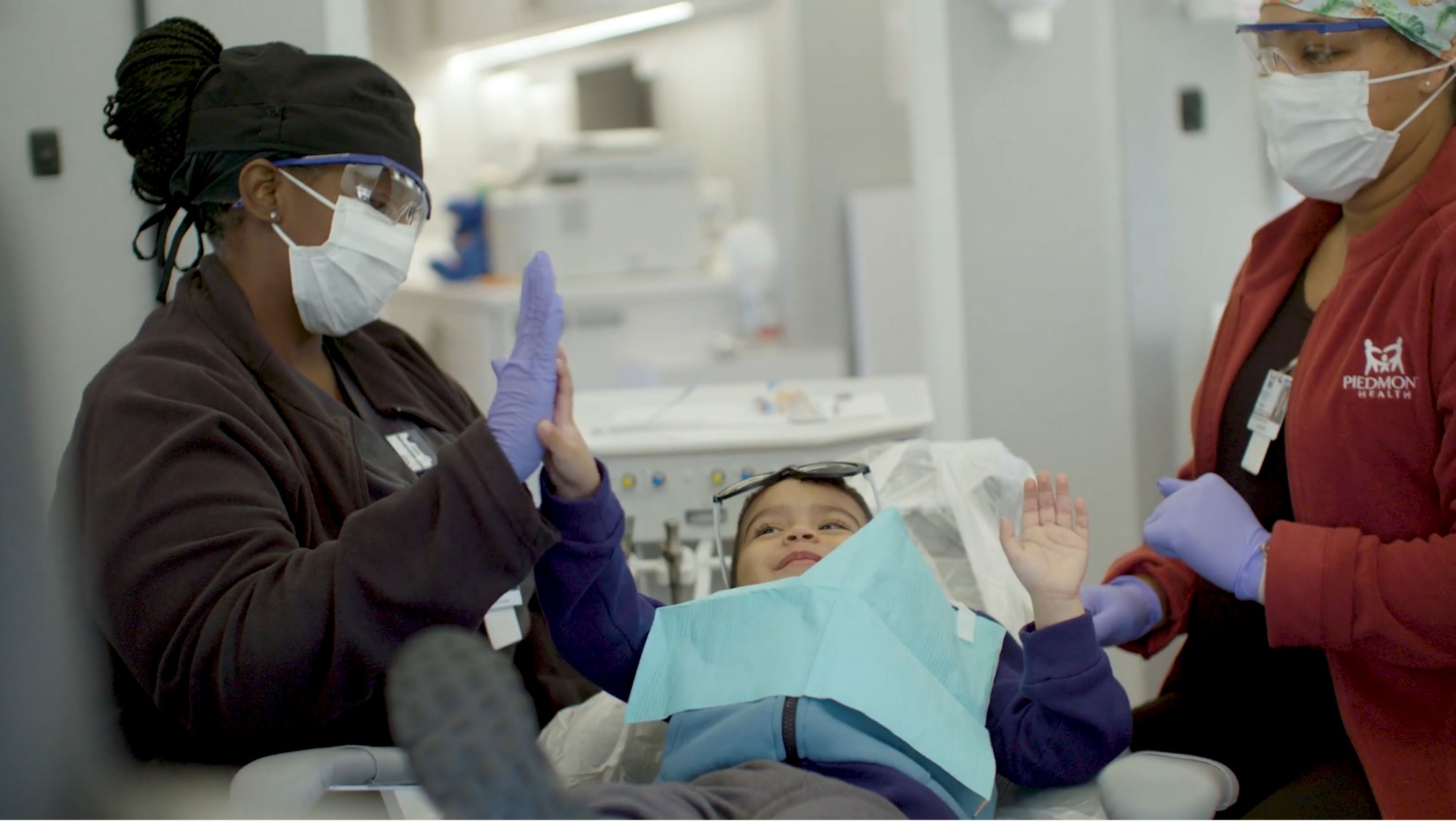
School-based mobile dental programs bring the unit to the schoolyard on a scheduled rotation, obtain parental consent in advance, and treat students during the school day. The model works because it collapses the logistics that normally keep children out of a dental chair. Care that would otherwise require a parent to find transportation, take unpaid time off, and navigate a new office instead happens in the parking lot while the child is already at school.

A typical program runs in a few coordinated steps.

1. Partner and schedule

Establish agreements with schools or a district, set a recurring visit calendar, and identify space and parking for the unit. Predictability is what builds trust and volume.

2. Consent and screening

Send consent forms home ahead of the visit, screen participating students, and flag those who need treatment. Track consent return rates early, because they drive everything downstream.

3. Treat and refer

Provide cleanings, sealants, fluoride, and restorative care on-site to the extent the unit and staffing allow. Refer complex cases to a named partner clinic with a warm handoff, not just a phone number.

4. Follow up

Confirm that referred students actually received care, and schedule the next rotation. Follow-up is where many programs lose ground, so build it into the staffing plan rather than treating it as an afterthought.

Because reducing missed appointments is one of the documented benefits of the school-run model, the consistency of the schedule and the strength of the referral loop are the two things worth protecting most.


How do you plan and sustain one?

You plan a mobile dental program by starting with the population and the need, then working backward to the unit, the staffing, and the money. The sequence matters. Buying a coach before you have defined who you serve and how you will pay for years two and three is the most common way these programs stall.

Three planning decisions carry the most weight.

Design the unit around the service mix. Decide whether you are running prevention and screening, full restorative care, or both, then size the operatories, imaging, and sterilization to match. Working through equipment solutions at this stage prevents costly retrofits later.

Hire staff dedicated to the mobile program. Staff a mobile dental team that belongs to the mobile program, not clinicians pulled from a fixed site on a rotation. Dedicated staff build continuity with the community and keep the program running on its own schedule. When a mobile unit depends on borrowed fixed-site clinicians, it becomes the first thing cut the moment the fixed site loses a provider, and the community loses the care it had come to rely on. Advisory support on planning and staffing can help you structure a team that is stable from the start.

Build a funding path past the grant. Map reimbursement, contracts, and renewable funding early so the program does not end when the launch grant does. Sustainability is a design choice, not a later scramble.

For a full walkthrough of these steps, the how to start a mobile health clinic guide covers need assessment, unit selection, staffing, and financing in order.


Frequently asked questions


How much does a mobile dental clinic cost to run?

Costs vary widely by unit size, service mix, and staffing, so there is no single figure. The main drivers are the unit and its equipment, the dedicated clinical team, vehicle operation and maintenance, and supplies. Plan for ongoing operating costs, not just the upfront purchase, and map a funding path that continues after the launch grant ends.


Can a mobile dental unit do fillings and extractions, or only screenings?

It depends on how the unit is configured. Smaller vans often focus on screenings, cleanings, and sealants, then refer patients out for complex work. Larger coaches with full operatories can provide fillings, extractions, and other restorative care on-site. Decide your service mix first, because it determines the equipment and staffing you need.


Are school-based mobile dental programs effective?

Yes. Mobile dental units reach and engage underserved populations better than fixed clinics and reduce missed appointments when run in partnership with schools, because the school setting removes the transportation and time barriers that keep children out of care. The strength of the referral loop and the consistency of the visit schedule determine how much of that benefit a program captures.


Who should staff a mobile dental clinic?

Staff the program with a team dedicated to the mobile unit, typically a dentist or dental therapist, hygienists, and dental assistants, along with a coordinator for consent, scheduling, and follow-up. Avoid rotating clinicians in from a fixed site, because that arrangement breaks community continuity and makes the mobile program the first to be cut when the fixed site is short-staffed.


How do you keep patients from falling through the cracks after a screening?

Build the referral and follow-up loop before you launch. Identify a named partner clinic for care that exceeds on-site capacity, use warm handoffs rather than a phone number, and assign someone to confirm that referred patients actually received treatment. Follow-up is where many programs lose ground, so it belongs in the staffing plan from day one.

Ready to bring oral health care to the communities that need it most? Explore MMM's mobile dental solutions to plan, build, and sustain a program designed around your population.

1 min read

Maternal Oral Health: Why Dental Care Belongs in Pregnancy, and How Mobile Delivers It

Oral health is a routine part of pregnancy care that most pregnant patients never get. Roughly 40% of pregnant people have some form of periodontal...
Read More

1 min read

Mobile Pediatric and School-Based Health Clinics

A mobile school-based health clinic is a fully equipped vehicle that brings pediatric care directly to school campuses, delivering well-child visits,...

Read More
Dental Grant Opportunities

1 min read

Dental Grant Opportunities

Dental health is a fundamental part of overall health and well-being, yet many people, particularly those in rural and low-income areas, do not have...

Read More