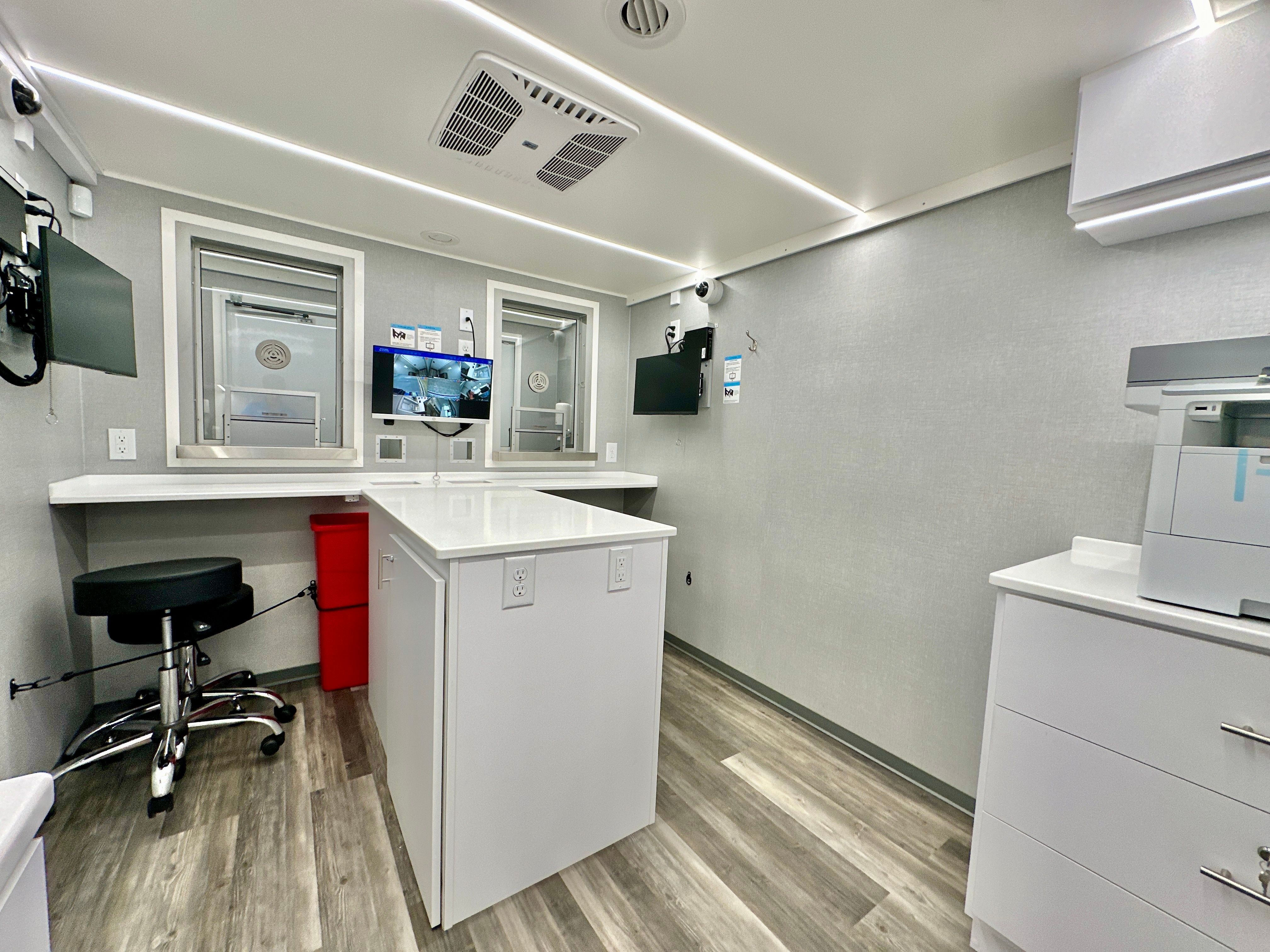
Employers that want care closer to employees choose among three models. An onsite clinic is a room or suite inside the workplace. A near-site clinic is a separate location a short drive away, often shared by several employers. A mobile clinic is a medical unit that visits the workplace on a set schedule and spends the rest of the week at other sites.
All three can offer primary care, screenings, vaccines, and occupational health. The choice turns on how many employees work at one address, how many addresses there are, and how much the employer wants to build.
Near-site clinics are now the most common model
Among firms with 50 or more employees that offer health benefits and have an employer clinic, the 2023 KFF Employer Health Benefits Survey found that 57 percent had a near-site clinic, 34 percent an onsite clinic, and 10 percent both. Near-site clinics let several employers share one location and give employees' families a place to go without entering the workplace.
Mobile clinics do not appear as a separate category in that survey. The 2025 worksite health center survey from the National Association of Worksite Health Centers covers "onsite, near-site, mobile, and virtual health centers" together.
The models compared
| Onsite clinic | Near-site clinic | Mobile clinic | |
|---|---|---|---|
| Location | Inside the workplace | Nearby, separate building | Parks at the workplace on set days |
| Best fit | One large site | Several employers or sites in one area | Small or mid-size sites, rural plants, several locations |
| Employee travel | None | A short drive | None on clinic days |
| Hours | Often daily | Often daily, sometimes evenings | Scheduled days per site |
| Space and build-out | Employer provides space | Leased or owned by operator | Vehicle plus parking and power at each site |
| Sharing | One employer | Several employers | Several employers on a weekly route |
| Families and dependents | Harder; requires site access | Easier | Possible at some stops |
The table describes typical arrangements. Contracts vary, and a single employer can combine an onsite clinic at headquarters with a mobile unit for outlying sites.
Workforce size usually decides the model
An onsite clinic needs enough visits every day to keep a clinician busy. That math works at a campus with thousands of employees and fails at a plant with 300. KFF Health News reported that 30 percent or more of firms with 1,000 or more workers offered an on-site or near-site clinic in 2023, compared with about 20 percent of firms with 200 to 999.
A mobile unit spreads the same clinician across several workplaces. In North Carolina, FirstHealth of the Carolinas used one unit to serve five employers in Montgomery County, visiting a 300-person factory once a week. The factory paid a flat daily fee for its clinic day.
Location and schedule set the limits
An onsite clinic is open whenever the clinic is staffed, so an employee with a sore throat on Tuesday can be seen on Tuesday. A mobile clinic that visits on Thursdays cannot. Programs cover the days between visits with telehealth, a referral relationship with a nearby clinic, or more stops per week at larger sites.
Mobile units also need a level parking spot, a safe path for employees, and in many cases a power hookup. The post on mobile clinic sites, routes, and scheduling covers what to check before the first visit.
Evidence on the models is thin
Research on employer clinics is mostly industry surveys, and research on mobile clinics is mostly program descriptions. A scoping review by Sabo and colleagues (2025) examined 38 studies of mobile health clinics published from 2017 to 2024 and found wide variation in settings, services, and the professionals on board. For an employer, that variation means a mobile program can be built around the services a workforce needs, provided the employer and operator define those services up front.
Choosing a model
Five facts about the employer usually settle the choice and point to one model or a mix:
- The number of employees at each location and the number of shifts
- The distance to the nearest primary care clinic and the wait for an appointment
- The services that matter most, such as chronic disease care, occupational health, or vaccines
- Whether the employer wants to serve dependents
- The space, parking, and power available at each site
A single site with several thousand employees can support an onsite clinic. Several mid-size sites in one county often fit a near-site clinic or a mobile route. Rural plants, multiple small locations, and employers testing the idea before building are the clearest fit for a mobile unit.
Our hub on mobile worksite clinics for employers explains how the mobile model works end to end, and the guide on how to start a mobile health clinic covers planning. Mission Mobile Medical's planning and staffing advisors help health systems and employers decide which model fits a workforce and design the route.