1 min read
Meeting the Broader Health Needs of People Who Use Drugs
Meeting the broader health needs of people who use drugs means delivering primary care alongside substance use services, because the same people who...
6 min read
Mollie Williams, DrPH, MPH
July 2, 2026
Street medicine is the practice of delivering health care directly to people experiencing homelessness where they live, in encampments, under bridges, in parks, and on sidewalks, rather than waiting for them to reach a clinic. Teams go to patients on foot or by mobile unit, provide primary care, wound care, behavioral health, and substance use treatment on the spot, and build the trust that eventually connects people to ongoing care and housing. The approach exists because the fixed system misses this population: people living unsheltered often cannot keep a clinic appointment, and by the time they do reach care, it is frequently in an emergency department. Street medicine meets them first.
The model is established and growing. Street medicine programs operate in over 140 cities across 27 countries. The reason communities invest in it is both humane and financial: people experiencing homelessness use the emergency department at more than three times the general-population rate, and street medicine defers ED and hospital visits. This post explains what street medicine is, how it differs from a fixed or shelter clinic, what the evidence shows, how it connects to substance use and behavioral care, how a mobile unit supports the work, and how to fund and staff a program.
Street medicine is health care delivered to people experiencing homelessness in the places they actually stay, not in a clinic they are asked to travel to. A team locates patients where they are, provides care in the moment, and returns to the same locations over time so care continues rather than starting over at each encounter.
The work spans primary care, wound care, chronic disease management, behavioral health, and substance use treatment, delivered outdoors or from a vehicle. What sets it apart is that the patient never has to come in. Mobile clinics deliver preventive, diagnostic, maternal, chronic disease, dental, and behavioral care in communities without a fixed site, and street medicine applies that reach to the streets themselves. Continuity is the whole point: returning to the same encampment week after week builds the trust that lets a person accept a wound dressing, then a medication, then a referral. That relationship is the bridge from a first contact on the sidewalk to sustained care and, eventually, housing.
Street medicine differs from a fixed clinic or shelter clinic in one decisive way: it removes the requirement that the patient show up. A fixed clinic waits for people to arrive. A shelter clinic reaches only those inside a shelter on a given night. Street medicine goes to people wherever they are, including the many who avoid shelters entirely.
The distinction matters because the barrier is the trip itself. Transportation barriers cause delayed or foregone care for up to 3.6 million people a year and account for a quarter or more of missed appointments, and for someone living unsheltered without a phone, an address, or a reliable way to travel, those barriers are close to absolute. A shelter clinic narrows the gap but still depends on a person being in the shelter system. Street medicine closes it by making location irrelevant to access. The tradeoff is that the team works in harder conditions and must build trust before care, which is why the model relies on repeated, consistent presence rather than a one-time outreach visit.
The evidence shows that street medicine reduces reliance on the most expensive parts of the health system while improving engagement in ongoing care. The clearest signal is in emergency department use, which is where unmet need among people experiencing homelessness tends to surface.
People experiencing homelessness use the emergency department at more than three times the general-population rate, and street medicine defers ED and hospital visits. Meeting people on the street with primary care, wound care, and medication addresses problems before they become emergencies, which moves care out of the ED and into a lower-cost, more effective setting. Beyond the cost story, the model changes whether people stay in care at all: street medicine improves engagement and retention, including continuation of medication for opioid use disorder. That combination, fewer emergency visits and more people held in ongoing treatment, is the outcomes case that supports both the clinical value and the budget argument.
Street medicine connects closely to substance use and behavioral care because those needs are common among people living unsheltered and are best addressed in the same trusted encounter rather than referred out and lost. A team that treats a wound can also start or continue medication for opioid use disorder and screen for behavioral health needs in the same visit.
The retention evidence is specific on this point: street medicine improves engagement and retention, including continuation of medication for opioid use disorder. Continuity is what makes this possible, because staying on medication depends on a reliable point of contact, and for someone unsheltered the street medicine team is often the only one they have. Integrating behavioral health into the same program keeps people from falling through the referral gap. When needs exceed what the team carries, a behavioral health satellite clinic network gives the program a place to route people for deeper care without breaking the relationship that got them there. Using person-first care throughout, the goal is to hold people in treatment, not to make treatment conditional on their reaching a building.
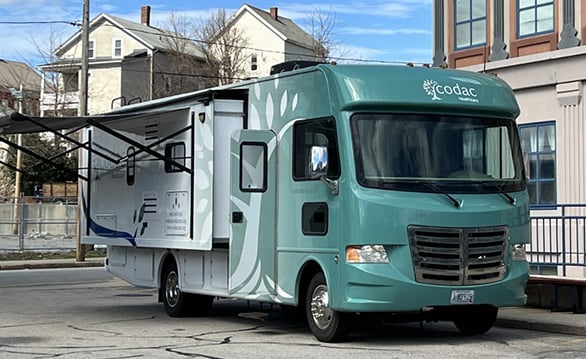
A mobile unit supports a street medicine program by extending what a team can carry and where it can go. Walking teams can reach patients on foot, but a mobile clinic adds a clinical space for exams and procedures, secure storage for medications and wound supplies, and the range to cover a wider service area on a route.
The unit becomes the program's mobile base: it holds equipment and records, provides a private space for sensitive conversations and treatment, and lets the team serve encampments and locations that are too far apart to cover on foot alone. It also raises the ceiling on what the program can deliver in a single visit, from wound care to medication to behavioral health screening. A mobile health operations plan is what turns the vehicle into a functioning route, setting the schedule, the resupply and records workflow, and the coordination with outreach and housing partners. The vehicle does not replace the walking outreach that finds people; it strengthens the care the team can give once it does.
You fund and staff a street medicine program by combining startup and operating sources and, above all, by hiring a team dedicated to the street work rather than borrowing clinicians from a fixed site. The staffing decision is the one that determines whether the program lasts.
On funding, braid the sources:
On staffing, hire clinicians dedicated to the street medicine program. Do not rotate fixed-site clinicians onto the unit. Rotation breaks the continuity that street medicine depends on, because trust is built through the same team returning to the same locations, and it makes the street program the first service cut when a fixed site loses a clinician. Budget the dedicated team as a permanent line item from the start. Where the program is part of a larger delivery system, it can connect into a primary care satellite clinic network that gives patients somewhere to step up to as they stabilize. A mobile health operations plan can build the staffing model, the route, and the budget as one plan.
Street medicine is health care delivered directly to people experiencing homelessness where they live, including encampments, sidewalks, and parks, rather than in a clinic they must travel to. Teams provide primary care, wound care, behavioral health, and substance use treatment on the spot and return to the same locations to build trust and continuity. The model exists because many people living unsheltered cannot reach or keep fixed-clinic appointments.
A shelter clinic serves people who are inside the shelter system, while street medicine reaches people wherever they are, including the many who avoid shelters. Street medicine removes the requirement that a patient show up anywhere, which is the barrier that keeps unsheltered people out of care. It relies on repeated, consistent presence to build the trust that care depends on.
Yes. People experiencing homelessness use the emergency department at more than three times the general-population rate, and street medicine defers ED and hospital visits by addressing problems before they become emergencies. Meeting people with primary care, wound care, and medication moves care into a lower-cost, more effective setting. This is a central part of the financial case for the model.
Street medicine programs operate in over 140 cities across 27 countries, making it an established and growing model rather than an experiment. That scale gives new programs a proven approach and a body of practice to build on. It also means funders and health systems increasingly recognize the model.
Staff it with clinicians dedicated to the street medicine program, not by rotating fixed-site providers onto the unit. Continuity is what makes street medicine work, because trust is built through the same team returning to the same places, and rotation both breaks that trust and makes the program the first to be cut when a fixed site is short-staffed. Fund the dedicated team as a permanent budget line from launch.
If you are building or expanding a street medicine program and want help with the mobile unit, staffing, route, and funding plan, contact us.
1 min read
Meeting the broader health needs of people who use drugs means delivering primary care alongside substance use services, because the same people who...
1 min read
Opioid addiction remains a major public health crisis, with devastating consequences for individuals, families, and entire communities. According to...
1 min read
Screening for substance use disorder means using a short, validated set of questions to identify people who may have a problem, then acting on the...