<img alt="" src="https://secure.agile-company-365.com/264630.png?trk_user=264630&amp;trk_tit=jsdisabled&amp;trk_ref=jsdisabled&amp;trk_loc=jsdisabled" height="0px" width="0px" style="display:none;">

5 min read

What Harm Reduction Is, and How Mobile Programs Deliver It

Harm reduction is a set of practical strategies that reduce the health risks of drug use for people who are still using, without requiring them to stop first. It meets people where they are. Instead of making abstinence the price of any help, harm reduction offers clean syringes, naloxone, testing, wound care, and a nonjudgmental relationship, and it lets those services become the path toward treatment when a person is ready. The evidence base is deep. Syringe services programs, one of the most studied harm reduction tools, have nearly 30 years of research behind them. For substance use treatment leaders, public health managers, and harm reduction operators, the question is rarely whether harm reduction works; it is how to deliver it where people actually are.

Harm reduction saves lives and moves people toward care at the same time. Syringe services programs are associated with about 50% lower HIV and HCV incidence among people who inject drugs, and people who use them are far more likely to enter treatment than people who do not. A mobile program can bring those services into communities that have no fixed site, which is often exactly where the need is greatest.


What is harm reduction?

Harm reduction is a public health approach that reduces the harms associated with drug use without requiring abstinence as a precondition for services. It accepts that people use drugs and works to keep them alive and healthier while they do, on the understanding that a living person can enter treatment later and a person turned away cannot.

In practice, harm reduction includes syringe services, naloxone distribution, drug-checking supplies like fentanyl test strips, wound care, testing for HIV and hepatitis C, and warm connections to treatment and other services. What ties these together is the stance behind them: services are offered without judgment and without conditions, so that people who distrust the health care system will accept help. That trust is the mechanism. It is what turns a syringe exchange into a doorway to treatment.


What does the evidence show on syringe services programs?

The evidence on syringe services programs is strong and consistent. After nearly three decades of study, SSPs are recognized as safe, effective, and cost-saving, and they do not increase drug use or crime. That last point addresses the most common objection to siting a program, and the research does not support the fear behind it.

The health effects are substantial. SSPs are associated with about 50% lower HIV and hepatitis C incidence among people who inject drugs. Reducing those infections matters at the population level: over 2,500 new HIV infections occur each year among people who inject drugs. Preventing transmission protects the person and everyone they might otherwise infect, and it avoids the lifetime cost of treating chronic infection, which is where much of the cost saving comes from.


How do naloxone and fentanyl test strips fit?

Naloxone and fentanyl test strips fit into harm reduction as tools that let people manage the immediate, lethal risks of an unpredictable drug supply. Naloxone reverses an opioid overdose; fentanyl test strips let a person check whether a drug contains fentanyl before using it. Both give people information and means to protect themselves in the moment.

These supplies also do relationship work. Handing someone naloxone and showing them how to use it is a low-barrier first contact that carries no requirement to change. That contact builds the trust harm reduction depends on, and it creates a natural opening to offer testing, wound care, or a connection to treatment. Distributing supplies and building relationships are the same activity, which is why programs that lead with naloxone and test strips often find people ready for more over time.


How do syringe services bridge people to treatment?

Syringe services bridge people to treatment by creating regular, trusted contact with a population that mostly avoids the health care system. People who use SSPs are about 5 times more likely to enter treatment and about 3 times more likely to stop injecting than people who do not use them. The program is not a detour from treatment; it is one of the more reliable routes into it.

The mechanism is the repeated, judgment-free relationship. Someone who comes for clean syringes returns, is known by name, and over time hears about medications for opioid use disorder, testing, and other care from people they have come to trust. When they are ready, the connection is already in place, so the step into treatment is short. A behavioral health satellite clinic network can make that step even shorter by putting treatment services alongside harm reduction, so the bridge leads somewhere immediate.


How can a mobile program deliver harm reduction?

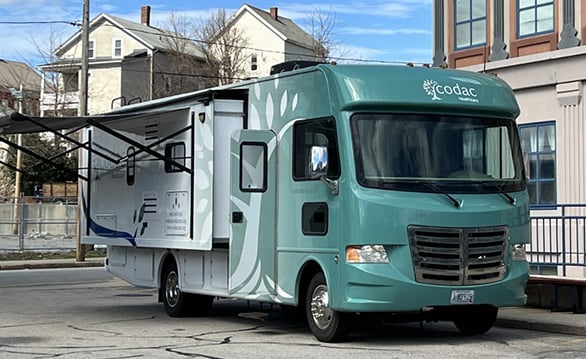
A mobile program delivers harm reduction by bringing supplies, testing, wound care, and treatment connections directly to communities on a predictable schedule, staffed by a team people recognize. Mobility solves the access problem that stops fixed-site programs from reaching people who are geographically isolated or unwilling to enter a clinic.

Building it well comes down to staffing, planning, and consistency:

  • Staff the program with dedicated mobile-program staff. Hire outreach workers, peer specialists, nurses, and clinicians assigned to the mobile program. Do not rotate fixed-site clinicians onto the unit. Harm reduction runs on trust built by the same people over time, and rotating staff breaks that continuity and makes the mobile program the first thing cut when a fixed site loses a clinician.
  • Keep a reliable schedule and route. People plan around a unit they can count on. Careful mobile health planning and staffing sets routes where need is highest and keeps the schedule steady.
  • Carry the full toolkit. Syringes, naloxone, fentanyl test strips, wound care supplies, and testing let one stop meet several needs.
  • Connect to treatment on the unit. Pair harm reduction with an on-board or referral path to MOUD so the bridge to care is short.
  • Follow the policy landscape. Rules on syringe access and drug checking vary and change; a program can track them through a policy center and adjust services accordingly.


How do you address stigma and siting?

You address stigma and siting by leading with evidence and building relationships with the community before the unit arrives. The most common objection, that a program will bring more drug use or crime, runs against the research: nearly 30 years of study shows SSPs are safe and do not increase drug use or crime. Bringing that evidence to local officials, neighbors, and law enforcement early changes the conversation.

Person-first, nonstigmatizing language matters here too, in public messaging and in the language staff use every day. Terms like "person who uses drugs" rather than stigmatizing labels signal that the program treats people as people, which both reflects the harm reduction stance and makes siting easier to defend. A mobile model has a practical advantage on siting: it does not require a permanent storefront, so a program can serve an area on a schedule and adjust routes as trust builds, rather than fighting a single fixed-location battle.


Frequently asked questions


Does harm reduction encourage drug use?

No. Nearly 30 years of research shows syringe services programs are safe, effective, and cost-saving, and that they do not increase drug use or crime. People who use these programs are about 5 times more likely to enter treatment and about 3 times more likely to stop injecting than people who do not. Harm reduction keeps people alive and connected to care rather than encouraging use.


What services does harm reduction include?

Harm reduction includes syringe services, naloxone distribution, fentanyl test strips and other drug-checking supplies, wound care, testing for HIV and hepatitis C, and connections to treatment. What unites these is that they are offered without requiring abstinence and without judgment. That approach builds the trust that leads people toward treatment when they are ready.


Do syringe services programs help people get into treatment?

Yes. People who use syringe services programs are about 5 times more likely to enter treatment and about 3 times more likely to stop injecting than people who do not use them. The regular, trusted contact these programs create is one of the more reliable routes into treatment. Pairing them with medications for opioid use disorder shortens the step into care further.


How does harm reduction reduce HIV and hepatitis C?

Syringe services programs give people who inject drugs access to clean supplies, which reduces the sharing that transmits HIV and hepatitis C. They are associated with about 50% lower HIV and HCV incidence among people who inject drugs. With over 2,500 new HIV infections each year among people who inject drugs, that reduction prevents both illness and its long-term cost.


If you lead a public health or treatment program and want to bring evidence-based harm reduction to communities without a fixed site, a mobile unit can carry the full toolkit and the trust that comes with it. Learn how a behavioral health satellite clinic network can deliver harm reduction and a short bridge to treatment where people already are.

1 min read

How to Screen for Substance Use Disorder  and Connect People to Care

Screening for substance use disorder means using a short, validated set of questions to identify people who may have a problem, then acting on the...
Read More

1 min read

The Many Pathways to Recovery: How Mobile Programs Provide Flexible Support for People with SUD

Recovery is a process through which a person improves their health and well-being, lives a self-directed life, and works toward their full potential...

Read More
Mobile Clinics: A Powerful Tool to Address Opioid Addiction

1 min read

Mobile Clinics: A Powerful Tool to Address Opioid Addiction

Opioid addiction remains a major public health crisis, with devastating consequences for individuals, families, and entire communities. According to...

Read More